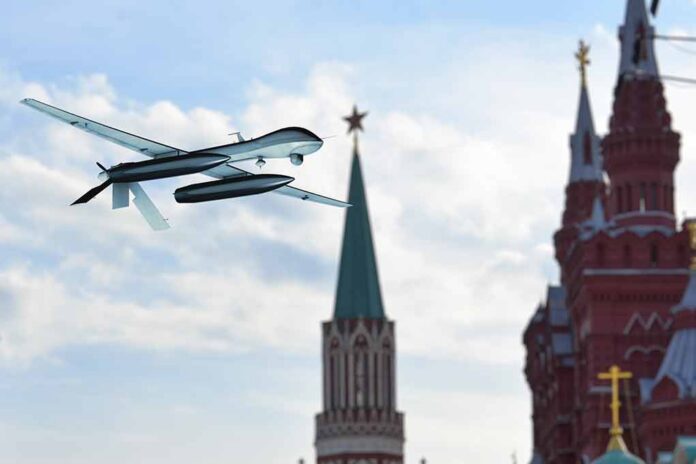
Russia has turned a cheap Molniya attack drone into a rolling lesson in wartime improvisation, using a $2 magnetic compass to keep flying through Ukrainian jamming.
Quick Take
- Russian forces fitted Molniya attack drones with a basic magnetic compass.
- The drone’s onboard camera reads the compass during flight.
- The change is meant to help the drone hold course when satellite navigation is jammed.
- The compass fix is described as the fourth navigation workaround on this airframe in about six months.
How the Compass Fix Works
Ukrainian defense ministry adviser Serhii “Flash” Beskrestnov said Russian forces attached an ordinary magnetic compass to the Molniya airframe and placed it where the camera can see it. The operator or onboard system can then tilt the camera down and check direction without depending on satellite signals. That matters because electronic warfare has made satellite navigation a weak point across the battlefield.
Images and reporting from the field show a very simple setup. The compass is bolted or screwed to the drone’s body, and the camera periodically looks down at it during flight. That kind of off-the-shelf fix fits a broader pattern in the war, where both sides keep using cheap parts and fast field repairs to answer new jamming methods. In this case, the low price is almost beside the point. The real story is how quickly Russian forces keep adjusting the same drone to stay useful.
Why This Matters on the Battlefield
The Molniya line has become a moving target for engineers on both sides. According to reporting on the latest compass setup, this is the fourth jam-resistant navigation change Russia has fielded on the same basic plywood airframe in about six months. That steady churn shows how drone warfare now rewards speed, not polish. When jamming knocks out one method, crews test another and send it back into the fight, often with little more than a camera, wires, and a cheap part from a store shelf.
That pattern should alarm anyone watching the military balance in Eastern Europe. A low-cost drone that can keep moving when satellite links fail gives Russian forces another way to pressure Ukrainian defenses and strike from a distance. It also shows how electronic warfare no longer ends the fight. It only starts another round of tinkering. For taxpayers and defense planners, the lesson is blunt: a weapon does not need to be advanced to be dangerous if it keeps adapting faster than the countermeasure.
A Wider Trend in Drone Warfare
The compass fix is not an isolated stunt. Other recent reporting has described Russian Molniya drones with autonomous features, including versions that fly without a control antenna and use a camera and onboard computer instead. Ukrainian officials have also warned that Russian drone development keeps moving toward more independence from radio links. That trend fits the larger modern pattern: when a battlefield is saturated with jamming, the side that builds the simplest backup wins time and keeps options open.
“Russian engineers are bolting a magnetic compass onto cheap Molniya drones. An onboard camera periodically tilts down to read the compass, giving the drone a way to hold its bearings even when every satellite signal it depends on has been jammed into static.”
— West Coast Intel (@WestCoastIntel) July 17, 2026
For now, the compass story is a reminder that battlefield innovation is often ugly, cheap, and fast. The Molniya drone does not need a glamorous upgrade to stay relevant. It needs a way to keep its nose pointed in the right direction when Ukrainian defenses try to blind it. That is why this tiny hardware change has drawn attention. It shows how a modest fix can extend the life of a low-cost attack drone and make a costly jamming campaign work harder for every mile of airspace.
Sources:
19fortyfive.com, dialog.ua, newsukraine.rbc.ua, united24media.com, facebook.com