A brutal late-night subway beating of a sleeping rider near Union Square shows, yet again, how New York’s transit system still leaves law‑abiding Americans at the mercy of street thugs while city leaders downplay the danger.
Story Snapshot
- Three suspects beat and robbed a sleeping man on a southbound 4 train near Union Square, then fled into the station.
- The attack fits a wider pattern of violent assaults on subway riders, including people who are simply asleep or trying to help others.
- Union Square and key 4 train stops have become repeat hotspots for slashings, robberies, and random beatings over the past decade.
- Data show subway assaults have surged since before the pandemic, even as officials insist overall crime numbers look “low.”
Sleeping Rider Beaten and Robbed on Union Square 4 Train
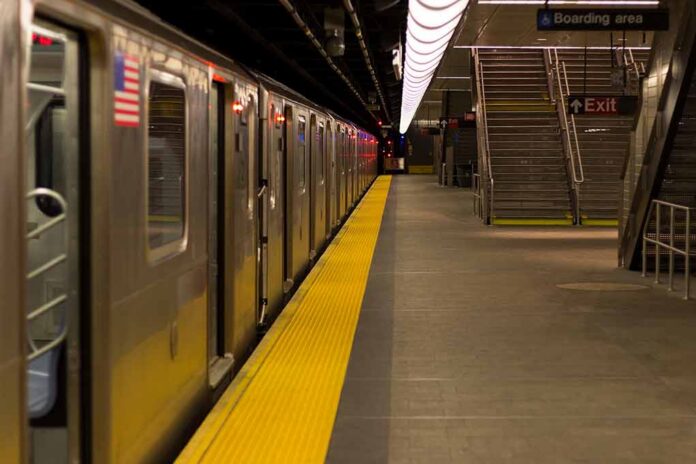
Police say the latest attack happened around 3:30 a.m., when a 32-year-old man was asleep on a southbound 4 train rolling into the 14th Street–Union Square station. Three suspects all dressed in black walked up to the sleeping rider and began punching him over and over across his body, turning a quiet ride into a sudden ambush. Officers say the attackers grabbed his cellphone, tried to rip his watch off his wrist, then ran off into the station before anyone could stop them.
Emergency medical workers took the victim to New York–Presbyterian Lower Manhattan Hospital, where he was listed in stable condition after the beating. The New York City Police Department released clear surveillance images of the three suspects and asked the public for help identifying them, a step that has become common as repeat subway offenders dodge accountability. For many riders, the fact that a man can be beaten and robbed simply for sleeping on a train shows how fragile basic safety still is underground, even after years of promises from local leaders.
Pattern of Subway Violence Against Vulnerable Riders
This is not an isolated horror story. Transit police and reporters have documented case after case where subway riders are attacked precisely when they are most vulnerable, especially while asleep. In one Queens case, four men allegedly attacked a homeless passenger sleeping on a 7 train, punching and kicking the 69-year-old man as they tried to steal his belongings; the victim fought back with a knife and one attacker was killed during the struggle. In another incident, two thieves beat a 70-year-old homeless man sleeping in a downtown station, smashing his face and stealing just $95 before fleeing and leaving him bloodied on the platform.
Even those trying to do the right thing are not safe. A 55-year-old man on an A train in Howard Beach tried to protect another rider from four suspects; the group turned on him, punched him in the face, sprayed him with liquid, and stole electronics and clothing worth nearly $2,500 before escaping. In another reported case, a “good Samaritan” in Queens was pummeled unconscious while trying to break up a dispute, then robbed not once but twice while he lay out cold on the train. These incidents send a clear message to everyday New Yorkers: if you fall asleep, mind your own business, or even step in to help, you can become a target in seconds.
Union Square’s Troubling Record and the Bigger Crime Picture
Union Square is one of the busiest hubs in the system, and it has a long record of brutal subway crime. Back in 2015, data showed Union Square among the stations with the highest number of assault complaints in the city. Since then, riders there have seen repeated slashings, stabbings, and robberies on platforms and trains, including attacks on women waiting for trains and riders stabbed during arguments that spilled onto the station. The new beating of a sleeping man on the 4 train near this station fits a well-known pattern that many city commuters have come to dread.
At the same time, think tank Vital City and other analysts report that felony assaults in the subway have climbed sharply over the last decade, rising about 96 percent from 2014 to 2024 even as ridership bounced back after the pandemic. Their review found that by 2023, assault cases in the subway finally outnumbered robberies, marking a major shift from earlier years when theft was the main problem. While the chance of being attacked on any single ride is still around one in a million, the risk today is far higher than it used to be, and these violent cases are exactly the ones that shake public trust in the system.
Political Spin Versus Rider Reality
Some state and city leaders point to aggregate numbers and say major subway crimes are near historic lows, once they adjust for pandemic years and ridership swings. That claim may be technically true on paper, but it does little for the man beaten in his sleep, the seniors and homeless riders left bloodied, or the good Samaritans punished for stepping in. For many Americans watching this from outside New York, the disconnect feels familiar: officials highlight charts, while working people face dangerous reality on the ground.
Under President Trump’s second term, federal leaders have pushed local governments to stop coddling criminals and start protecting regular citizens again. But New York City’s day-to-day safety still depends on the choices of its own mayor, prosecutors, and transit bosses. When violent attackers can repeatedly beat, slash, and rob riders at known hotspots like Union Square, and still stay on the streets, it fuels the sense that big-city policies favor excuses and “reforms” over consequences. Law-abiding Americans expect better: a subway where you can ride home, even half-asleep after a long shift, without wondering if three masked thugs will decide you are their next easy mark.
Sources:
nypost.com, audacy.com, nbcnewyork.com, abcnews.go.com, fox5ny.com, cbsnews.com, transitapp.com, nytimes.com, vitalcitynyc.org, abc7ny.com