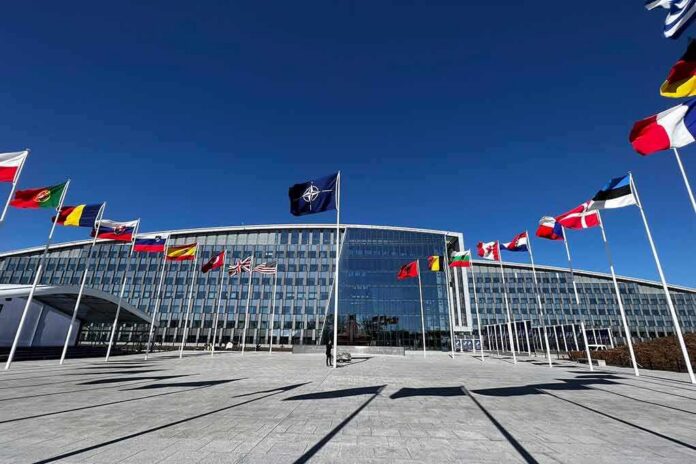
A young intern inside NATO’s nerve center in Europe now stands accused of spying for a foreign power and ties to organized crime, raising fresh alarms about Western security in an age of global tension.
Story Snapshot
- Belgian prosecutors arrested a Canadian woman of Chinese origin who interned at NATO’s Supreme Headquarters Allied Powers Europe on spying charges.
- Authorities say she is suspected of espionage for an unnamed third country and of membership in a criminal organization.
- NATO’s own security services reportedly flagged the intern, triggering a federal investigation in Belgium and searches of her home and workplace.
- Officials insist NATO operations and readiness were not harmed, but the incident exposes insider-threat risks in Western defense institutions.
Intern Arrested Inside NATO Command Hub in Belgium
Belgian federal prosecutors say a Canadian woman of Chinese origin who worked as an intern at NATO’s Supreme Headquarters Allied Powers Europe, known as SHAPE, in Mons has been arrested on spying charges. The Federal Public Prosecutor’s Office announced she is suspected of spying on behalf of a “third country” and of being a member of a criminal organization, putting the case squarely in the national security and organized crime arena. Her name and the country she allegedly served have not been released, and prosecutors say no further personal details will be disclosed for now to protect the investigation. The suspect was detained on Friday after investigators moved on both her home and her workplace inside the NATO command facility, signaling that officials treated the situation as a serious insider threat rather than a minor workplace issue.
Belgian authorities say the case began when NATO’s own security services at SHAPE noticed the intern and raised concerns, then passed their tip to Belgian intelligence officials. That referral led the Federal Public Prosecutor’s Office to open an espionage investigation focused on the intern’s conduct inside the alliance’s operational headquarters, which directs NATO military missions. Federal judicial police carried out searches at the suspect’s residence and her office space at SHAPE, looking for evidence that could confirm or rebut the claims of foreign spying and criminal links. After these searches, the woman was taken into custody and placed under formal arrest as the investigation continues under an investigating judge in the Mons division, within Belgium’s federal court system.
Allegations, Secrecy, and Unknowns in the Espionage Case
Public reporting from Belgian officials focuses on the accusation that the intern spied for a third country and belonged to a criminal organization, but it does not describe what she is claimed to have done. There is no released information about which documents, systems, or conversations she could access during her time at SHAPE, or whether any classified files, devices, or messages were seized during the police searches. Belgian prosecutors have deliberately withheld the name of the alleged foreign state, making it impossible for outsiders to judge motive or geopolitical context from official records alone. Authorities also have not identified the supposed criminal organization or any other suspects, leaving key questions open about whether she acted alone or as part of a wider network tied to foreign intelligence or transnational crime.
The lack of detail fits a common pattern in espionage and counterintelligence cases, where governments reveal broad charges early but hold back evidence to protect sources, methods, and future leads. That secrecy can be vital to security work, yet it also means news coverage and public debate are driven almost entirely by official statements before any facts are tested in court. In this case, multiple outlets, from Reuters to Canadian and European broadcasters, carried nearly identical descriptions of the arrest and accusations on the same day, showing that nearly all information flows from a single prosecutorial narrative. As a result, citizens hear that a suspected spy was inside NATO’s military brain, but they still do not know how strong the proof is, how wide the breach might reach, or whether others have been questioned or detained in connection with the case.
NATO Response and Insider-Threat Concerns for the West
NATO officials at SHAPE responded to questions by stressing that the arrest has not harmed the alliance’s core military functions, including operational readiness, command and control, or ongoing missions. A SHAPE spokesperson said the headquarters continues to carry out its responsibilities without interruption, aiming to reassure member states that this suspected espionage incident did not cripple coordination in Europe. The statement suggests that either the intern’s access was limited or that any potential exposure was quickly contained, though those specifics remain behind closed doors. For Western governments, including the United States under President Trump, the case underscores how even low-level insiders can pose outsized risks if hostile actors slip through security screens at key defense sites.
🇧🇪🇨🇦🕵️🇨🇳 A Canadian intern of Chinese origin at NATO’s SHAPE headquarters in Mons, Belgium, was detained under an arrest warrant on suspicion of espionage for an unidentified third country and participation in a criminal organization.
The investigation began after SHAPE security…
— Nuclear-ID (@NuclearID68) July 26, 2026
Security experts who study insider threats note that most damage does not come from movie-style master spies, but from ordinary staff or interns who gain quiet access and share information over time. NATO and Belgian authorities now face pressure to review vetting, monitoring, and reporting processes inside SHAPE to ensure that this arrest reflects a successful catch, not the tip of a larger failure. Conservative readers who worry about globalism and soft security have fresh reason to demand tougher screening and clear accountability when foreign-linked personnel work near sensitive Western defense planning. At the same time, the suspect has not yet faced a public trial, and officials have released no direct evidence, so the case will likely unfold slowly as Belgian courts and investigators decide how much the public will learn about what happened inside NATO’s headquarters in Mons.
Sources:
thegatewaypundit.com, reuters.com, straitstimes.com, bloomberg.com, brusselstimes.com